You cannot see inside the Sun. No telescope, however good, can look past its blinding surface. And yet we have a detailed map of its hidden interior, layer by layer, down toward the core. We got that map by listening.
The Sun is ringing
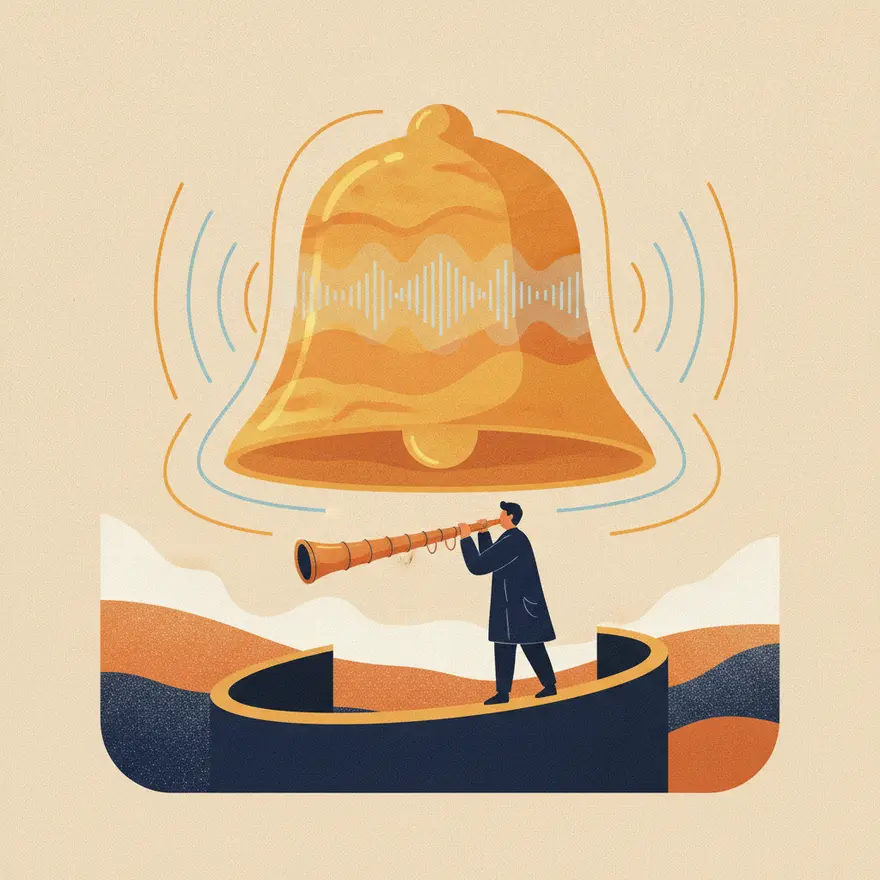
The Sun is not silent. Deep inside it, sound waves are bouncing around constantly, and they make its surface rise and fall by small amounts, over and over. The whole star is vibrating, a little like a struck bell that never stops being struck.
The field that reads those vibrations is called helioseismologyHelioseismologyThe study of the Sun's interior by watching the sound waves that ripple across its surface. Just as geologists read earthquakes to map the inside of the Earth, physicists read the Sun's surface vibrations to map what lies beneath it. full glossary entry . The name borrows from seismology, the study of earthquakes. Geologists learn what is inside the Earth by watching how earthquake waves travel through it. Solar physicists do the same trick with the Sun, using its own internal sound instead of earthquakes.
What the waves are made of
The waves we measure are mostly p-modesp-modeOne of the Sun's natural sound-wave patterns, where ordinary gas pressure is the force pushing the wave along (the "p" stands for pressure). These are the main waves helioseismologists measure. full glossary entry . That is just a sound wave trapped inside the Sun, with ordinary gas pressure doing the pushing. Millions of them overlap at once. On their own they would be hopeless noise, but each pattern travels through a different depth, so each one carries back a different clue.
By carefully separating the patterns, we can work out the temperature, the density, and even the speed of material flowing at depths we will never visit.
Why it matters
The Sun drives every scrap of weather, climate, and life on Earth, and it occasionally hurls storms of charged particles at us that can knock out power grids and satellites. Reading its interior is how we learn what it is about to do. Better measurements mean better warning.
That is the quiet power of this method: we are charting the inside of a star from ninety three million miles away, using nothing but the sound it makes.