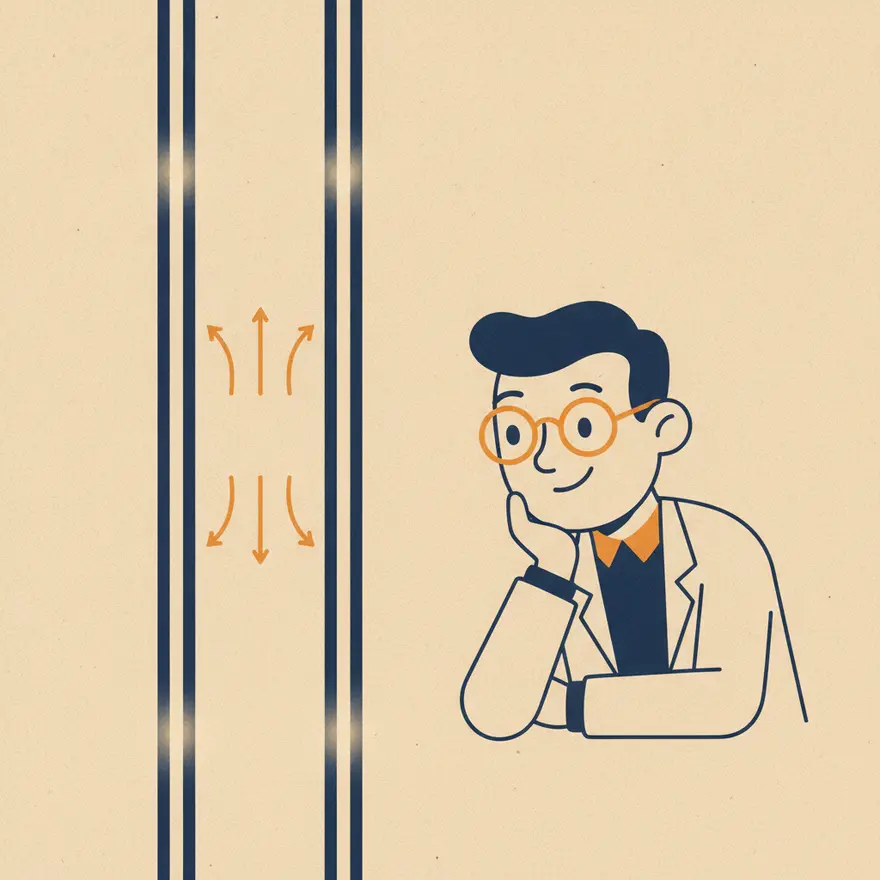
Imagine two ordinary wires, side by side. There are no magnets nearby, just the wires themselves. When you send electricity through them in the same direction, they gently pull towards each other. If you send the electricity in opposite directions, they push apart. This surprising effect, where electricity alone creates a physical force, was a profound discovery.
For centuries, electricity and magnetism were seen as separate phenomena. Then, in 1820, Danish physicist Hans Christian Ørsted made a pivotal observation: an electric currentElectric currentA flow of electric charge, usually electrons moving through a wire. It is what powers and connects almost every electrical device. full glossary entry could move a compass needle. This showed a direct link between electricity and magnetism. Ørsted’s discovery was a breakthrough, but it was qualitative. It showed that a current produced a magnetic effect, but it left a deeper question unanswered: could electricity directly exert a force on other electricity, without any magnets involved?
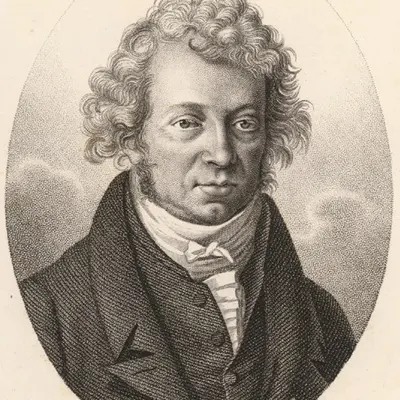
French physicist André-Marie Ampère heard of Ørsted’s finding and immediately grasped its potential. He asked the sharper question: if a current acts like a magnet, can one current push or pull another? Within weeks of Ørsted’s announcement, Ampère began meticulous experiments in Paris. He set up two parallel wires and passed currents through them. What he found confirmed his intuition.
When currents flowed through the wires in the same direction, the wires attracted each other. When the currents flowed in opposite directions, the wires repelled each other.
Scientists were stunned. This was not a magnet acting on a magnet. This was electricity acting directly on electricity, through a force that we now understand is mediated by magnetic fields created by the currents themselves.
But for Ampère, this qualitative discovery was just the beginning. He wanted a universal law, a mathematical rule as fundamental as Newton’s law of gravity. To find it, he had to go deeper than just observing long, straight wires.
The force between two parallel wires was one specific case. But what about wires bent into circles, or wound into coils? The force would surely change with the geometry. Ampère realized that to create a law that worked for any shape, he could not treat the wires as single objects. He had to understand the force exerted by one tiny, almost point-like segment of a current-carrying wire on another. This conceptual leap from whole circuits to infinitesimal “current elements” was the key to unlocking the problem.
Of course, you cannot physically isolate a tiny piece of current. It must be part of a complete circuit. So Ampère designed a series of ingenious experiments using wires of different shapes and orientations. By building apparatus where parts of the circuit could move freely, he could carefully measure the resulting forces. From these measurements, he could mathematically deduce the underlying rule governing the interaction between the tiny segments. It was a masterpiece of experimental design and logical inference.
The law he formulated was profound. It stated that the force between two small segments of current depends on several factors: the strength of each current, the length of each segment, the distance between them, and crucially, their orientation in space. It was a complete description. With this law, one could, in principle, calculate the total force between any two circuits, no matter how complex, by adding up the tiny forces between all their constituent parts.
Ampère’s work established the fundamental principles of what he termed electrodynamicsElectrodynamicsThe branch of physics that studies the interactions between electric currents and the magnetic fields they produce. full glossary entry , the study of electric charges in motion and their interactions. His rapid, rigorous work transformed a curious observation into a foundational branch of physics.
This understanding is essential for countless technologies. Electric motors, which convert electrical energy into mechanical motion, operate on the principle of forces between current-carrying conductors within magnetic fields. Without Ampère’s insights, the design and development of such motors would have been far more difficult.
His contributions were so significant that the international unit of electric currentElectric currentA flow of electric charge, usually electrons moving through a wire. It is what powers and connects almost every electrical device. full glossary entry is named the ampereAmpereThe Ampere is the standard international (SI) unit for measuring electric current, representing the flow of one coulomb of electric charge per second. full glossary entry , often shortened to “amp.” While the technical definition of the ampere has evolved (it was redefined in 2019 based on a fixed value for the elementary charge), its name continues to honor Ampère’s profound legacy in establishing the precise relationship between electricity and magnetism.