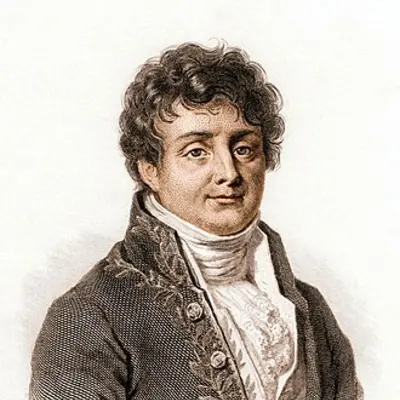
A trumpet blast, a heartbeat trace, the wobble of a star. Each signal looks unique and complex. Yet each can be built by adding together simple, plain repeating waves. They can also be taken apart the same way. This powerful idea, published in 1822 by French mathematician Joseph Fourier, revolutionized how we analyze and engineer the world.
Fourier’s journey began with a practical, if seemingly dull, problem: how heat spreads through a solid object. Imagine a long metal bar heated unevenly. One end might be scorching, the middle just warm, and the other end cool, with sharp changes in temperature along its length. This was not just an academic puzzle. Fourier was working in an era of great industrial and scientific ambition in France. He needed practical tools to solve real-world engineering problems related to heat transfer. The existing mathematics struggled with anything but the simplest, most idealized temperature patterns.
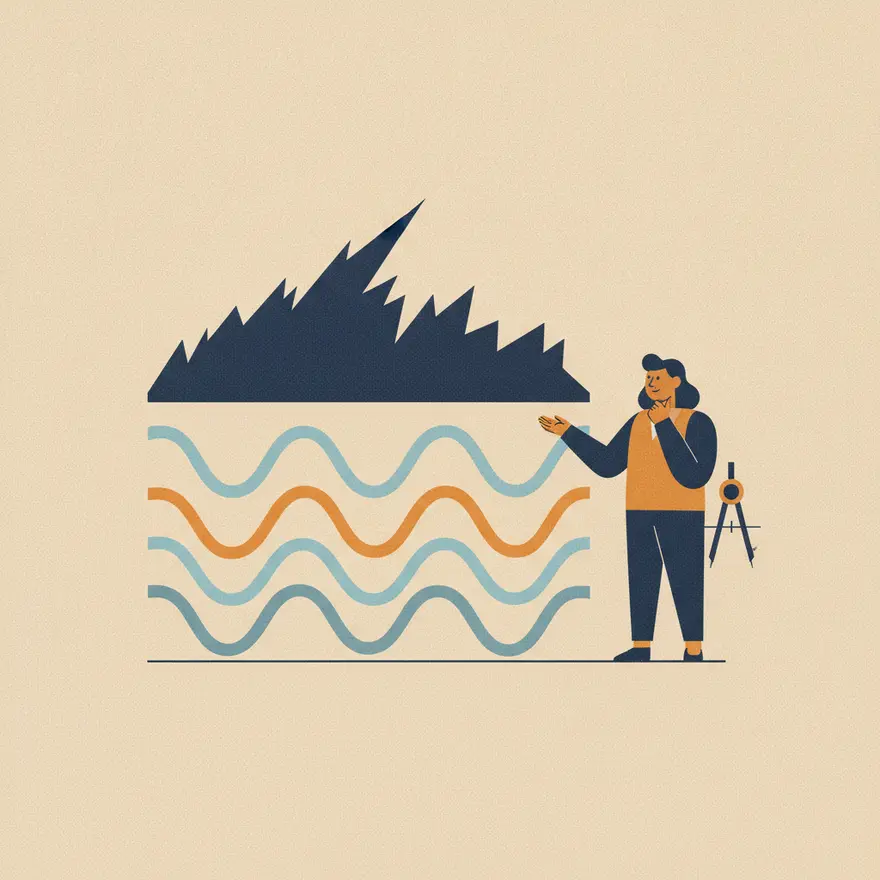
His crucial insight was a mathematical detour. Instead of trying to find one complex formula for every possible starting pattern, he proposed representing the temperature as a sum of simple, smooth waves added together.
Think of the purest, most regular wave you can, like the ripple from a pebble dropped in a calm pond. This is a good picture of a sine waveSine WaveA smooth, symmetrical, repeating wave pattern, like the ripples on a pond or the path of a pendulum. It describes a regular, oscillating motion. full glossary entry . It is a smooth, predictable, up-and-down curve that repeats perfectly. Fourier proposed that even a very jagged temperature pattern could be perfectly matched by adding together many different sine waves. Each of these component waves would have its own height (its amplitude) and its own frequencyFrequencyHow often a repeating event or wave pattern occurs in a given amount of time. Higher frequency means more repetitions per second. full glossary entry , which describes how many times it repeats over a certain distance.
It’s like mixing colors. You can create any color imaginable by starting with just three primary colors and mixing them in the right proportions. Fourier showed you could do the same for signals. The “recipe” starts with a base sine wave, called the fundamental, which captures the main shape of the signal. Then, you add smaller, faster waves called harmonics. These are sine waves whose frequencies are exact multiples of the fundamental. By carefully choosing the size of each harmonic and adding them all up, you can build a signal that matches the original complex pattern with astonishing accuracy.
The idea was so radical that many leading mathematicians of the day, including the great Joseph-Louis Lagrange, were deeply skeptical. The objection was profound. Sine waves are infinitely smooth, with no sharp edges. How could adding them together ever create a sudden jump or a sharp corner? It challenged the very definition of what a function was. Fourier’s claim rested on an infinite sum of these waves, a concept that made many of his contemporaries uneasy. It took decades for other mathematicians to establish the full rigor behind the idea, but its power was undeniable. The process of breaking a signal down into its basic wave ingredients is now known as a Fourier seriesFourier SeriesA mathematical way to represent almost any repeating pattern or signal as a sum of simple sine waves, each with its own amplitude and frequency. This process is also known as Fourier decomposition. full glossary entry or Fourier decompositionFourier SeriesA mathematical way to represent almost any repeating pattern or signal as a sum of simple sine waves, each with its own amplitude and frequency. This process is also known as Fourier decomposition. full glossary entry .
This discovery became a hidden engine behind countless modern technologies. When you listen to an MP3, you are hearing Fourier’s work. The complex sound wave of a song is broken down into its component frequencies. The compression algorithm then discards the frequencies that are too high or low for humans to hear, or those drowned out by louder sounds. The result is a much smaller file that sounds nearly identical to our ears.
The same principle makes digital photos possible. A JPEG file breaks the image down into waves of varying brightness and color that exist across space. By discarding the high-frequency waves that represent tiny, sharp details the eye might not notice, the file size can be drastically reduced. In medicine, MRI scanners use Fourier techniques to convert raw radio signals from the body into a detailed image of organs and tissues.
What began as a clever tool for understanding heat flow became a universal lens for understanding signals. By breaking a complex whole into its simple, wavy parts, we can filter out noise, compress information, and find patterns hidden in the most complicated data the universe has to offer.