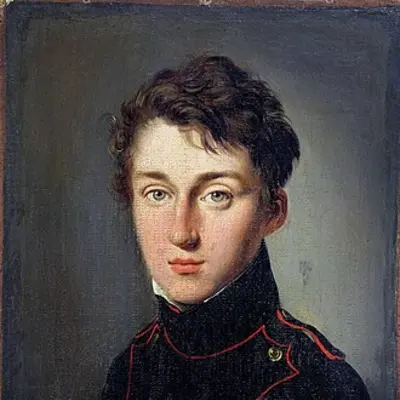
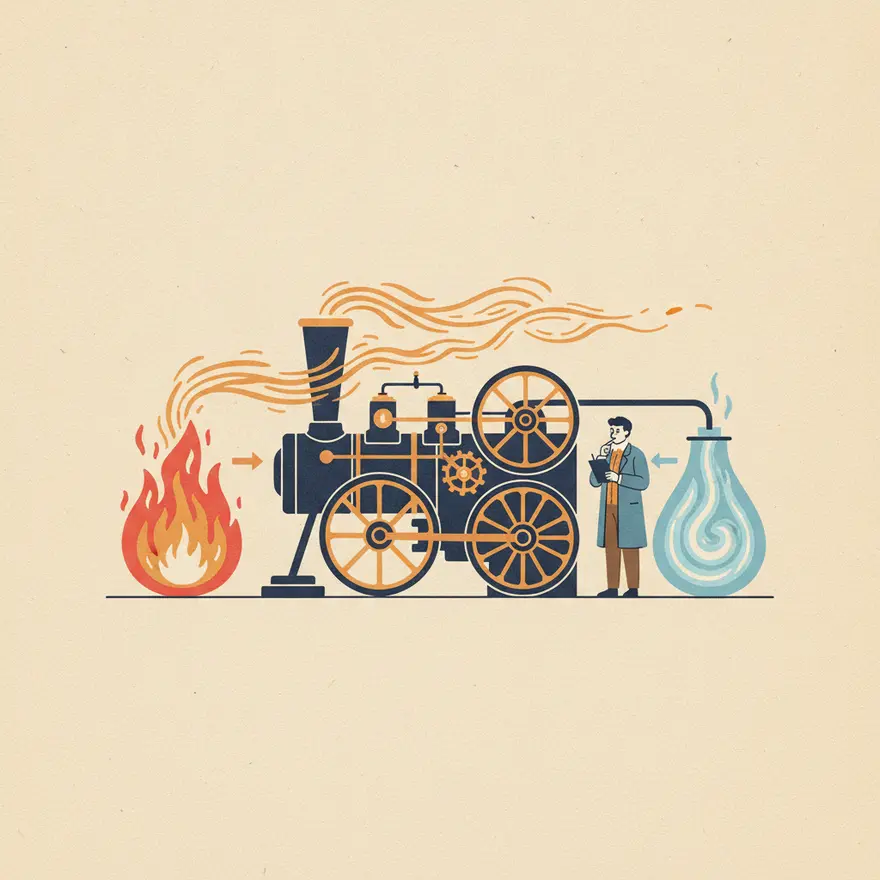
Imagine a power plant, a car engine, or even a simple steam engine. All of them burn fuel to create heat, then try to turn that heat into useful motion or electricity. It seems like a straightforward process, but there is a hard, unyielding limit to how much useful work you can wring from that heat. No amount of clever engineering can ever exceed it. This fundamental ceiling, an important insight into the nature of energy, was discovered by a young French engineer named Sadi Carnot in 1824.
In the early 19th century, the industrial revolution was in full swing, powered largely by steam engines. These machines were transforming factories and transportation, but their design was often a matter of trial and error. Engineers knew how to build them, but they didn’t truly understand the underlying physics that governed their operation. More importantly, no one knew if there was a theoretical best performance these engines could achieve. Was there an ultimate limit to how efficient they could be, or could engineers keep improving them indefinitely?
Carnot set out to answer this question. He imagined a perfect, idealized machine, a heat engineHeat EngineA device that converts thermal energy (heat) into mechanical energy (work) by exploiting a temperature difference between a hot source and a cold sink. full glossary entry , operating between two temperature reservoirs. A heat engine is any device that converts thermal energy (heat) into mechanical energy (work) by exploiting a temperature difference. Think of it like water flowing downhill: it can do work as it falls. Similarly, heat flowing from a hot place to a cold place can be harnessed to do work.
The key to Carnot’s reasoning was a thought experiment. He considered an engine that took heat from a hot source (like a boiler), used some of that heat to do work, and then expelled the remaining, unusable heat to a colder sink (like the surrounding air or a condenser). He reasoned that for an engine to be maximally efficient, its process must be reversible. This means the engine could theoretically run backward, using work to move heat from the cold sink back to the hot source, like a refrigerator.
At the time, scientists largely adhered to the caloric theoryCaloric TheoryAn early scientific theory, popular in the 18th and early 19th centuries, which proposed that heat was an invisible, weightless fluid that flowed from hotter to colder bodies. While later disproven, it was used by Sadi Carnot in his foundational work on heat engines. full glossary entry , which viewed heat as an invisible, weightless fluid. Carnot, too, used this theory in his reasoning. Despite this now-discarded understanding of heat, his logical framework was sound. He deduced that the maximum amount of work an engine could extract depended only on the temperatures of the hot source and the cold sink, and not on the specific type of fuel burned, the design of the engine, or the working substance (like steam or air) inside it.
The measure of how well an engine converts heat into work is called its thermodynamic efficiencyThermodynamic EfficiencyThe ratio of the useful work output by a heat engine to the total heat energy supplied to it, indicating how effectively heat is converted into work. full glossary entry . This is the ratio of the useful work output to the total heat energy supplied to the engine. Carnot showed that the absolute maximum thermodynamic efficiency for any heat engine operating between two given temperatures is determined solely by those temperatures. The larger the temperature difference between the hot source and the cold sink, the greater the potential efficiency.
This discovery meant that no real-world engine, no matter how well-designed, could ever exceed the efficiency of Carnot’s idealized engine operating between the same two temperatures. It established an unbreakable ceiling, a fundamental physical law. This also implied the impossibility of perpetual motion machines of the second kindPerpetual Motion Machine of the Second KindA hypothetical device that would continuously extract useful work from a single heat reservoir by cooling it down, without needing a colder sink to dump excess heat. Such a machine is impossible according to the Second Law of Thermodynamics. full glossary entry (devices that would continuously extract work from a single heat source without a cold sink, violating the need for a temperature difference).
Carnot’s work, published in his 1824 treatise, “Reflexions sur la puissance motrice du feu” (Reflections on the Motive Power of Fire), was largely overlooked during his lifetime. Tragically, he died young, at 36, in 1832. It was not until decades later that his ideas were rediscovered and championed by physicists Rudolf Clausius and Lord Kelvin. They recognized the immense significance of his findings, which became a foundational pillar of the Second Law of ThermodynamicsSecond Law of ThermodynamicsA fundamental principle of physics stating that the total entropy (disorder) of an isolated system can only increase over time, or remain constant in ideal, reversible processes. It implies that heat naturally flows from hotter to colder bodies and that it's impossible to convert all heat into useful work. full glossary entry .
Today, the Carnot limit remains a crucial concept. It sets the benchmark for everything from the design of power stations to the engines in our cars and even refrigerators. While engineers continue to innovate, they do so with the knowledge that Carnot’s principle sets an ultimate boundary on what is physically possible.