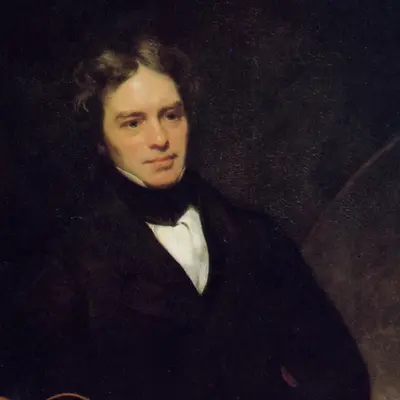
Michael Faraday left school at thirteen and trained as a bookbinder. He had almost no formal mathematics. He went on to discover one of the most useful facts in all of physics, and he did it by being relentless in the laboratory.
The question hanging in the air
By the 1820s, scientists knew that an electric current could create magnetism. Faraday asked the obvious flip side of the question. If electricity makes magnetism, can magnetism make electricity?
For years the answer seemed to be no. A magnet sitting next to a wire did nothing at all.
The thing he noticed
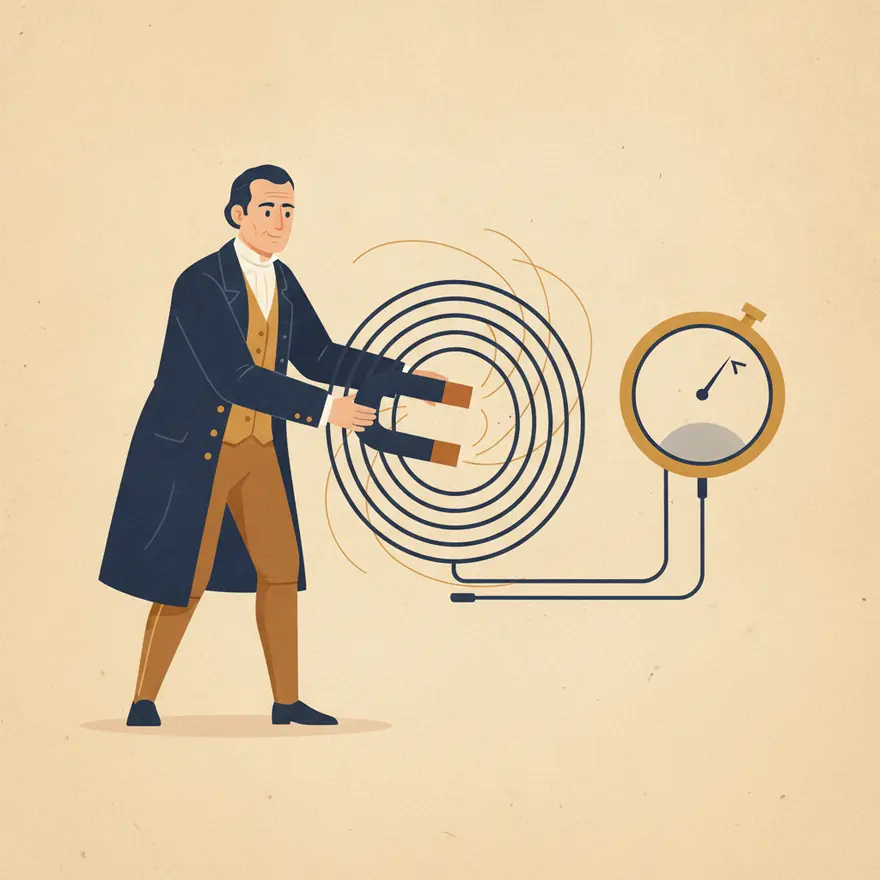
On 29 August 1831, Faraday found the missing piece. The magnet sitting still did nothing. But at the instant he changed the magnetism, a current jumped in the wire, then vanished. It was the change that mattered, not the magnet itself.
This is electromagnetic inductionElectromagnetic inductionThe effect where a changing magnetic field creates an electric voltage in a nearby wire. Move a magnet near a coil, or change the magnetism through it, and current flows. This is how generators turn motion into electricity. full glossary entry : a changing magnetic field drives an electric current in a nearby conductor. Move the magnet, switch it on, switch it off, and electricity flows. Hold it still and nothing happens.
Seeing fields where others saw empty space
Faraday could not lean on equations, so he leaned on pictures. He imagined invisible lines of force filling the space around magnets and wires, and he trusted those lines as real, physical things. Most mathematicians of his day thought this was naive.
It was not. A generation later, James Clerk Maxwell took Faraday’s lines of force and wrote them into the equations that still carry our entire understanding of electricity, magnetism, and light. The bookbinder’s intuition was right.
Why he still matters
Every power station that spins a magnet to make electricity is running on what Faraday found in 1831. He showed that careful, honest experiment, followed wherever it leads, can outrun even the mathematics of the age.