Imagine stirring a cup of coffee vigorously. You might notice it warms up slightly. This everyday observation hints at a profound connection between motion and warmth. For centuries, however, these two phenomena were considered entirely separate.
Before the mid-19th century, heatHeatEnergy that flows from a hotter object to a cooler one because of the temperature difference between them. Heat is energy in transit, not a substance stored inside things. full glossary entry was often thought of as a mysterious, invisible fluid called “caloric.” This fluid was believed to flow from hotter objects to colder ones. Mechanical motion, on the other hand, was understood as the movement of physical objects. There was no clear scientific understanding that these two seemingly distinct things could be related or interchangeable.
The Brewer’s Experiment
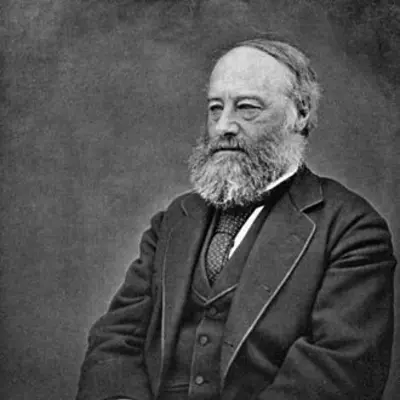
James Joule, a British brewer with a deep passion for physics, set out to investigate this relationship. He believed that if mechanical motion could produce heat, there must be a precise, measurable exchange rate between them.
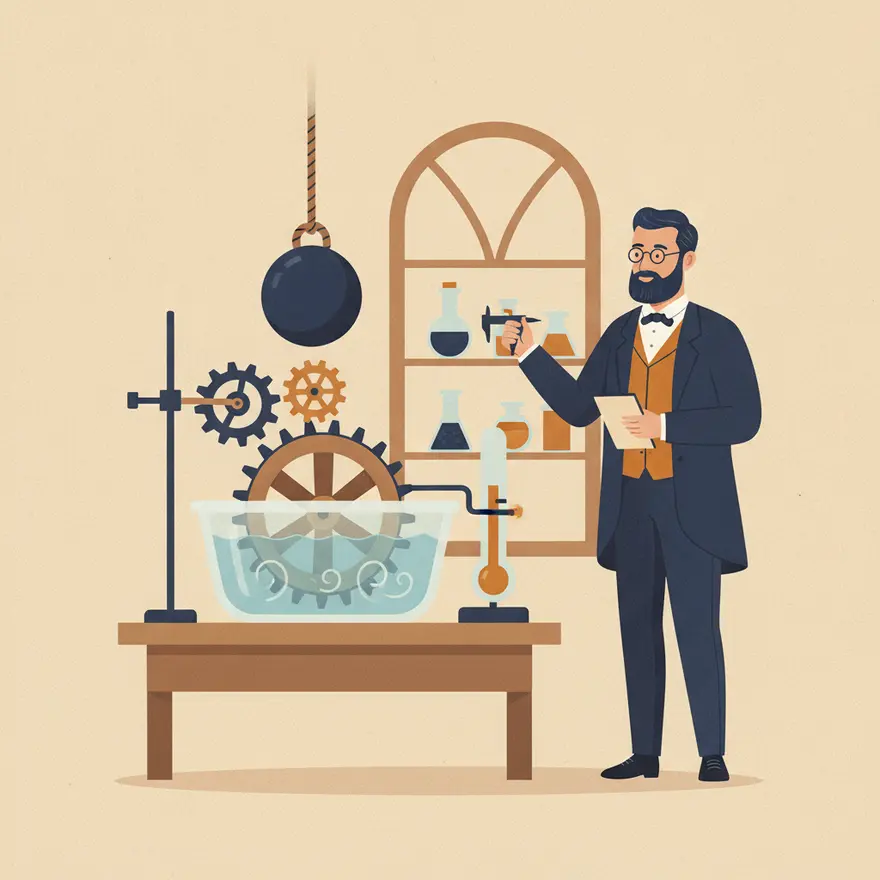
Between 1845 and 1850, Joule designed and refined a series of ingenious experiments. His most famous apparatus involved a set of falling weights. As the weights descended, they turned a paddle wheel submerged in an insulated tub of water. The friction generated by the spinning paddles against the water caused the water’s temperature to rise.
Joule’s experiment was simple in concept but meticulous in execution. He made two crucial measurements:
- The mechanical work done: He precisely measured the mass of the weights and the distance they fell. In physics, workWorkIn physics, work is energy transferred when a force pushes or pulls something through a distance. Lifting a weight or stirring water both do work. full glossary entry is done when a force causes an object to move a certain distance. This work represents the mechanical energyEnergyThe capacity to do work or cause change. It comes in many forms, including motion, heat, light, and chemical energy, and can be converted between them. full glossary entry put into the system.
- The heat produced: He used sensitive thermometers to measure the exact temperature increase of the water in the tub. Because the tub was well-insulated, he could be confident that the heat gain was due to the paddles, not external factors.
Joule repeated his experiments many times, using different materials and setups. Each time, he found a consistent ratio: a specific amount of mechanical work always produced a predictable amount of heat. He established that 772 foot-pounds of work were equivalent to raising one pound of water by one degree Fahrenheit. This fixed exchange rate became known as the mechanical equivalent of heatMechanical equivalent of heatThe fixed exchange rate between mechanical work and heat, showing the two are forms of the same thing, energy. James Joule measured it precisely. full glossary entry .
Energy: A Universal Currency
Joule’s precise measurements were revolutionary. They showed that mechanical work and heat were not separate entities but different manifestations of the same fundamental quantity: energy. Energy is the capacity to do work or produce heat. It can exist in many forms, such as the motion of the falling weights (kinetic energy), the stored energy of the raised weights (potential energy), or the warmth of the water (thermal energy).
This discovery was a cornerstone for the principle of conservation of energyConservation of energyThe principle that energy is never created or destroyed, only converted from one form to another. The total amount in a closed system stays the same. full glossary entry , also known as the First Law of Thermodynamics. This principle states that energy cannot be created or destroyed, only transformed from one form to another. The total amount of energy in an isolated system remains constant. While other scientists like Julius Robert Mayer, Hermann von Helmholtz, and Lord Kelvin also contributed to developing this broader principle, Joule’s unique contribution was providing the precise experimental proof that linked mechanical work and heat quantitatively.
In recognition of his groundbreaking work, the standard international (SI) unit of energy, work, and heat is now named the jouleJouleThe standard unit of energy, named after James Joule. One joule is about the energy needed to lift a small apple one metre. full glossary entry . One joule is the amount of energy transferred when a force of one newton moves an object one meter.
Joule’s work fundamentally changed our understanding of the physical world. It laid the foundation for thermodynamics, the study of heat and its relation to other forms of energy and work. His meticulous experiments paved the way for understanding how engines work, how power is generated, and how all energy transformations occur in the universe, from the smallest cell to the largest star.