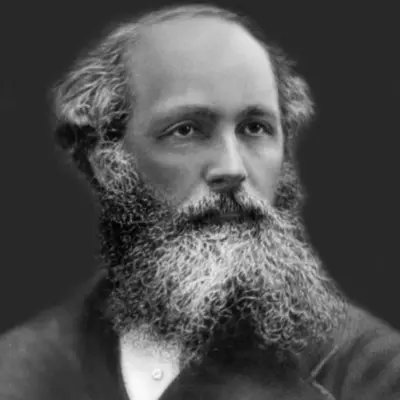
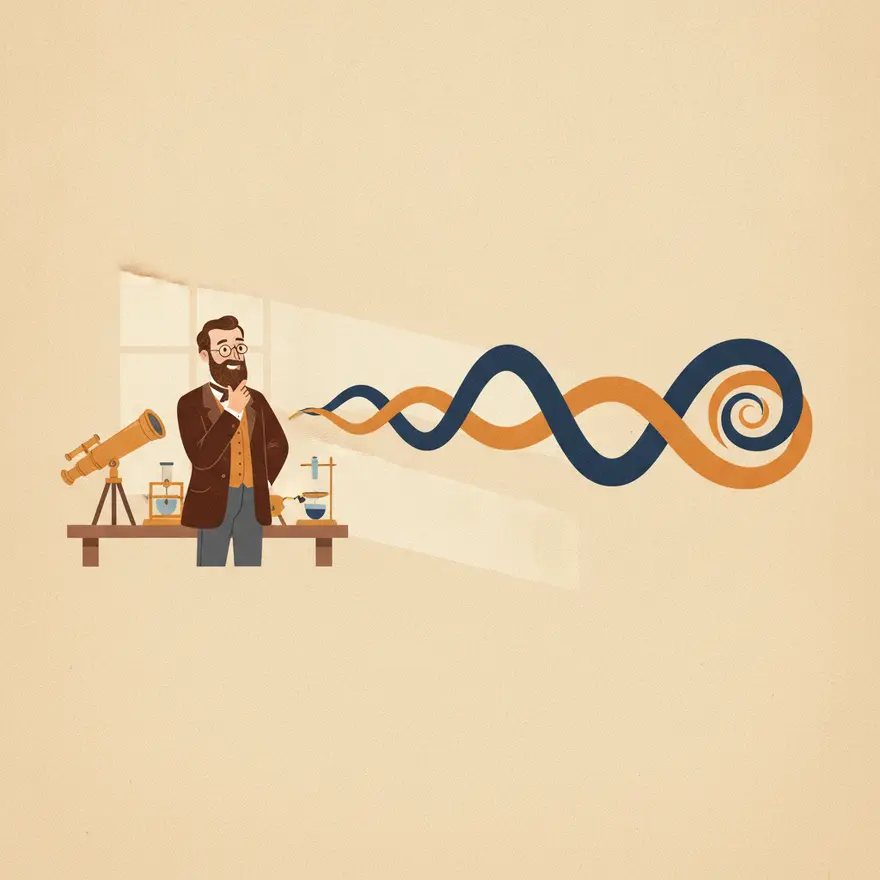
Imagine taking two completely unrelated measurements. One tells you about the strength of an electric force, the other about the strength of a magnetic force. Combine these two numbers in a simple equation, and what do you get? The speed of light. This astonishing result, first uncovered by James Clerk Maxwell in the 1860s, was no coincidence. It revealed a profound truth about the universe: light itself is an electromagnetic waveElectromagnetic WaveA wave made of oscillating electric and magnetic fields that travel through space at the speed of light, carrying energy. full glossary entry .
Before Maxwell, the worlds of electricity and magnetism were understood as separate, though linked, phenomena. Scientists like Hans Christian Ørsted had shown that electric currents create magnetic effects. André-Marie Ampère quantified how electric currents interact magnetically. Michael Faraday then demonstrated electromagnetic inductionElectromagnetic inductionThe effect where a changing magnetic field creates an electric voltage in a nearby wire. Move a magnet near a coil, or change the magnetism through it, and current flows. This is how generators turn motion into electricity. full glossary entry , showing that a changing magnetic field could generate an electric current. These discoveries, while groundbreaking, existed as a collection of distinct observations and rules. It was a tangle of insights, hinting at a deeper connection.
Maxwell’s Unification
James Clerk Maxwell, a Scottish physicist, saw the need to unify these disparate laws into a single, coherent framework. He did this by expressing them as a set of mathematical equations. In his original 1865 paper, he used twenty equations to lay out the theory. The compact, four-equation version familiar to physicists today was developed later by Oliver Heaviside. While the full mathematics is complex, the core ideas can be understood simply.
Here’s a plain-English summary of what Maxwell’s theory says:
- Electric charges create electric fields. An electric fieldFieldA region of space where a physical quantity (like force) has a specific value at every point. full glossary entry is a region around a charged object where other charged objects would experience a force. Think of it like the invisible influence around a magnet, but for electrical charges.
- Magnetic poles always come in pairs. You can’t have a north pole without a south pole. This means there’s no isolated “magnetic charge” equivalent to an electric charge.
- A changing magnetic field creates an electric field. This is Faraday’s law of induction. If you wave a magnet near a wire, you can make electricity flow.
- Electric currents create magnetic fields, and a changing electric field also creates a magnetic field. The first part was Ampère’s discovery. Maxwell’s crucial insight was adding the second part: that a changing electric field could also generate a magnetic field.
The Birth of the Electromagnetic Wave
This last point was revolutionary. It meant that a changing electric field could create a magnetic field, and according to Faraday’s law, that changing magnetic field would then create a new electric field, and so on. This process of mutual generation means that a disturbance in the electric and magnetic fields doesn’t just fade away. Instead, it can regenerate itself and travel through space. This self-propagating disturbance is what we call an electromagnetic wave.
Maxwell then did something extraordinary. He calculated the speed at which these theoretical electromagnetic waves should travel. This speed was determined by two fundamental constants that had been independently measured in experiments involving electricity and magnetism. When he plugged these measured values into his equations, the result was approximately 300,000 kilometers per second (186,000 miles per second).
This number was already known. It was the speed of light, which had been measured by astronomers and physicists for centuries. The match was too perfect to be a mere coincidence.
Light Revealed
Maxwell’s conclusion was profound: light is an electromagnetic wave. This meant that light, electricity, and magnetism were not separate forces but different manifestations of a single underlying phenomenon, the electromagnetic force.
Maxwell’s work not only explained the nature of visible light but also predicted the existence of other electromagnetic waves, differing only in their wavelength and frequency. These include radio waves, microwaves, infrared light, ultraviolet light, X-rays, and gamma rays.
While Maxwell predicted these waves, it was Heinrich Hertz who experimentally confirmed their existence in 1887. Hertz successfully generated and detected radio waves, demonstrating that they behaved exactly as Maxwell’s theory predicted, traveling at the speed of light and exhibiting wave-like properties.
Maxwell’s unified theory of electromagnetism fundamentally changed our understanding of the universe. It paved the way for countless technological advancements, from radio communication to medical imaging, by revealing the invisible spectrum of electromagnetic radiation that surrounds us.