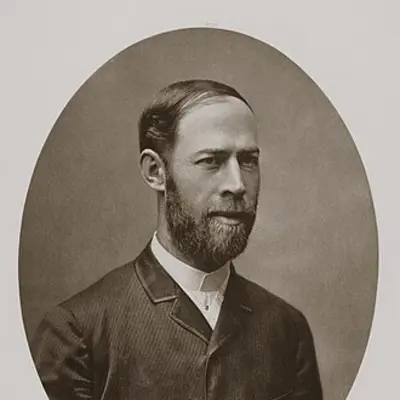
James Clerk Maxwell predicted invisible waves of electricity and magnetism crossing empty space. For two decades, his idea remained a brilliant but unproven theory. Then, in the late 1880s, Heinrich Hertz built a simple apparatus in his lab and actually caught these waves jumping from one side of the room to the other.
The story begins with Maxwell’s equations in the 1860s. His mathematics unified electricity and magnetism, showing they were two aspects of the same fundamental force. An electric field is the area of influence around an electric charge, while a magnetic field is the influence from a magnet or moving charge. Maxwell showed that a changing magnetic field creates an electric field, and a changing electric field creates a magnetic field.
This interconnected dance led to a startling prediction. If you could disturb these fields just right, they would create a self-sustaining ripple, an electromagnetic waveElectromagnetic WaveA wave made of oscillating electric and magnetic fields that travel through space at the speed of light, carrying energy. full glossary entry , that would travel outward through empty space. Maxwell calculated the speed of these theoretical waves and found it was identical to the known speed of light. He proposed that light itself was just one type of this wave. But for years, no one had managed to create or detect any other kind.
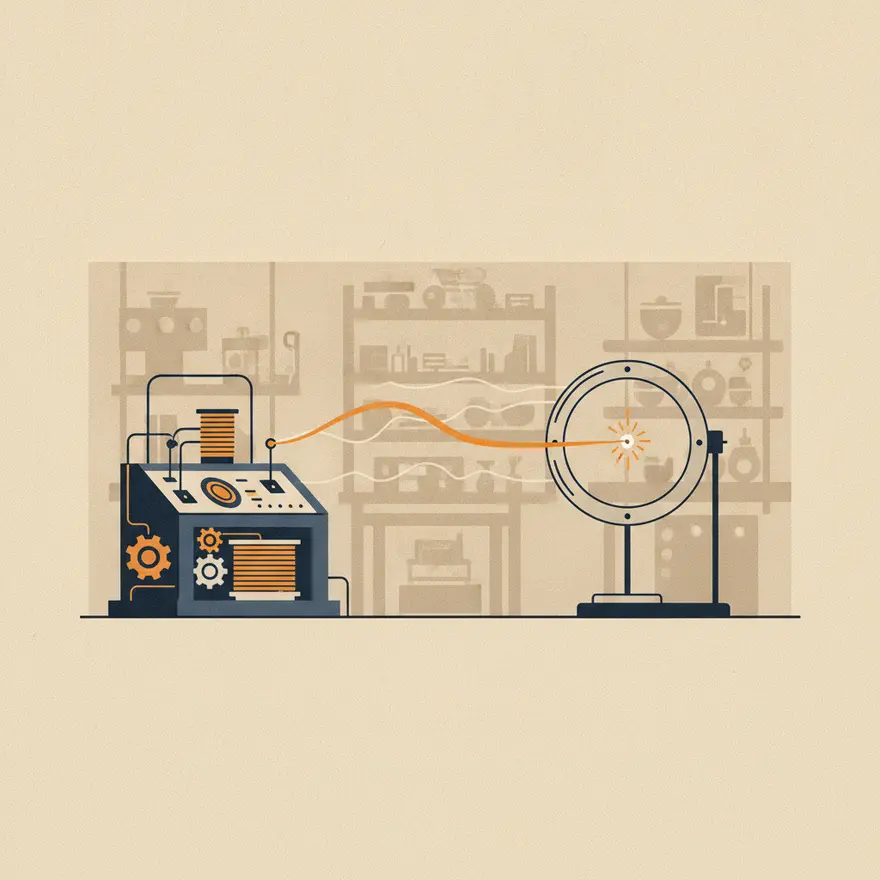
The challenge fell to German physicist Heinrich Hertz. He designed an experiment to generate and find these waves. For his transmitter, he used two metal rods with a small gap between their ends. He connected this setup to an induction coil, a device that generates a very high voltage. When turned on, the coil forced a powerful spark to jump across the gap. This spark was a violent, rapid oscillation of electric charge, which Hertz believed would send out the electromagnetic waves Maxwell had described.
To catch them, he built a simple detector: a loop of copper wire with its own tiny gap. He reasoned that if Maxwell’s waves were passing through this loop, they should induce a small electric current in the wire. This current would, in turn, create its own tiny spark across the detector’s gap.
Hertz set up his experiment, placing the detector several meters away from the transmitter. He had to work in a darkened room, as the expected spark in the detector would be incredibly faint. He activated the transmitter, and a bright, crackling spark jumped across its gap. He looked over at his detector loop. There, in the darkness, a tiny spark flickered in perfect sync with the transmitter.
There was no physical connection. Energy had traveled invisibly across the lab. This was the first, definitive proof that electromagnetic waves were real.
Hertz did not stop with this single observation. He began to systematically test the properties of his new waves. He placed a large sheet of zinc in their path and found they reflected off it, just like light from a mirror. He built large prisms out of pitch (a tar-like substance) and showed the waves could be refracted, or bent, just like light passing through glass.
Most importantly, he measured their speed. By reflecting the waves back toward the transmitter, he created a standing wave pattern in his lab. By measuring the distance between points of no activity, he could calculate the wavelength. Knowing the frequencyFrequencyHow often a repeating event or wave pattern occurs in a given amount of time. Higher frequency means more repetitions per second. full glossary entry of his spark generator, he calculated the waves’ speed. His result was a very close match to the speed of light. Maxwell was right.
Hertz’s work transformed a powerful theory into a physical reality. It proved that energy could be transmitted wirelessly. When asked about the practical applications of his discovery, Hertz reportedly saw none. He was focused on confirming a fundamental principle of physics, not inventing a technology.
He could not have foreseen that his demonstration of how to create and detect these waves was the essential first step for an entire field of technology. Within a decade, inventors like Guglielmo Marconi would build directly on Hertz’s findings to develop the first systems for wireless telegraphy. This work laid the foundation for radio, television, radar, and the wireless world we live in today. The unit of frequency, the hertz (Hz), is named in his honor, a recognition of the physicist who first caught Maxwell’s invisible waves.