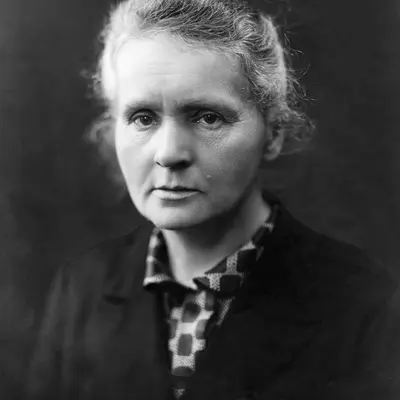
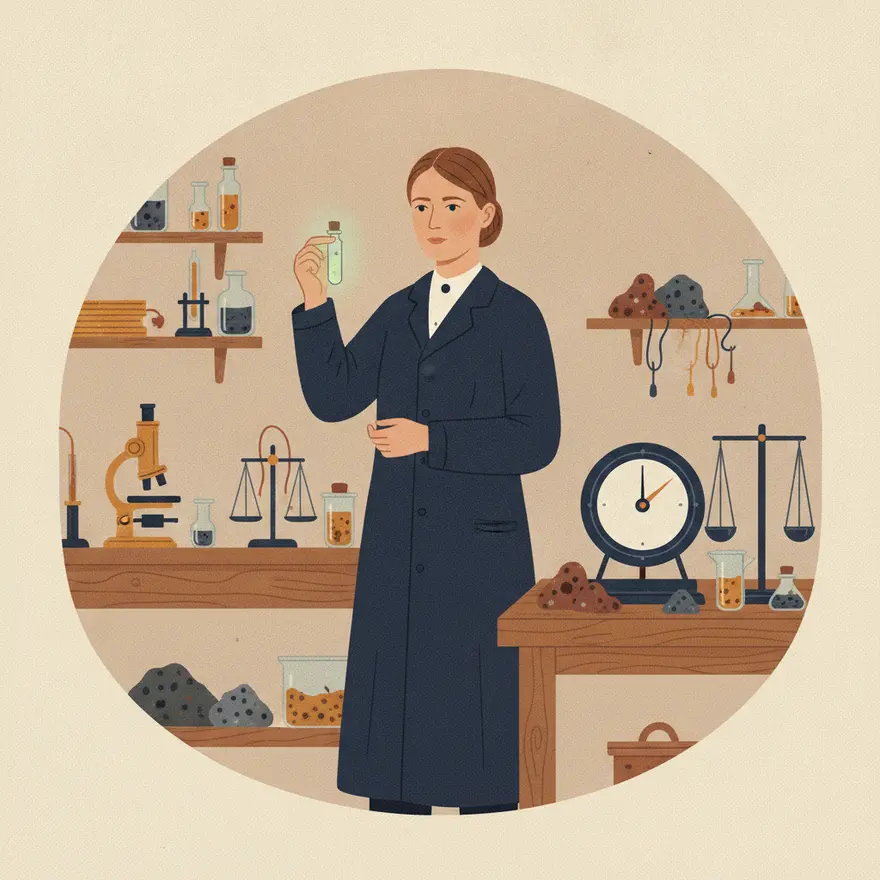
Imagine a piece of rock, sitting quietly in a dark room. It is not burning, no light shines on it, and yet, it constantly pours out invisible energy. How could this be? In the late 19th century, this mystery puzzled scientists. Marie Curie, with her meticulous work, would uncover the incredible truth: this energy comes from within the very heart of matter itself.
The story began in 1896, when French physicist Henri Becquerel stumbled upon a peculiar phenomenon. He had placed a uranium salt on top of a photographic plate wrapped in thick paper. To his surprise, even in complete darkness, the uranium emitted something that fogged the plate, just as light would. This was strange. The material was emitting energy without any apparent external stimulus. Becquerel had discovered what he called “uranic rays,” but he did not fully understand their origin.
Enter Marie Curie. A young, determined Polish scientist working in Paris, she was fascinated by Becquerel’s unexplained rays. She decided to investigate them for her doctoral research. Using a sensitive instrument to measure electric charge, she began to precisely quantify the strength of these rays. She tested various uranium compounds and minerals. Her crucial finding was that the intensity of the rays depended only on the amount of uranium present in the sample, not on its chemical form.
This was a profound insight. It meant the effect was not a chemical reaction, which involves how atoms combine with each other. Instead, the rays had to be coming from something fundamental within the atomAtomThe smallest unit of an element that retains the chemical identity of that element. full glossary entry itself. An atomAtomThe smallest unit of an element that retains the chemical identity of that element. full glossary entry is the smallest unit of an elementElementA pure substance consisting only of atoms that all have the same number of protons in their atomic nuclei. full glossary entry that retains the properties of that elementElementA pure substance consisting only of atoms that all have the same number of protons in their atomic nuclei. full glossary entry . An elementElementA pure substance consisting only of atoms that all have the same number of protons in their atomic nuclei. full glossary entry is a pure substance made of only one type of atom. Curie had shown that this mysterious emission was an intrinsic property of the uranium atom.
Driven by her findings, Curie hypothesized that other elements might also show this property. She and her husband, Pierre Curie, began a systematic search, testing every known elementElementA pure substance consisting only of atoms that all have the same number of protons in their atomic nuclei. full glossary entry and countless minerals. Their search led them to pitchblende, an ore rich in uranium. They were startled to find it was far more active than pure uranium. This suggested the ore must contain a new, unknown substance in tiny amounts. In 1898, after painstaking chemical work, the Curies isolated highly radioactive fractions from the pitchblende. The evidence was clear enough for them to announce the discovery of two new elementsElementA pure substance consisting only of atoms that all have the same number of protons in their atomic nuclei. full glossary entry that year. They named the first polonium, after Marie’s native Poland, and the second, even more active one, radium. The actual isolation of a pure sample of radium would take them four more years of hard labor, but the principle was established.
Marie Curie coined the term radioactivityRadioactivityThe spontaneous emission of penetrating rays or particles from the nucleus of an unstable atom. full glossary entry to describe this spontaneous emission of powerful rays. Her work was revolutionary. Before her discoveries, atoms were generally thought to be indivisible, inert, and unchanging particles. Her research proved that atoms were not dull, solid spheres but contained immense internal energy that could be spontaneously released. This opened up the entire field of nuclear physics, revealing a previously unknown source of energy within matter.
The discovery of radioactivityRadioactivityThe spontaneous emission of penetrating rays or particles from the nucleus of an unstable atom. full glossary entry and new radioactive elementsElementA pure substance consisting only of atoms that all have the same number of protons in their atomic nuclei. full glossary entry had immediate and lasting impact. It provided tools for understanding the structure of the atomAtomThe smallest unit of an element that retains the chemical identity of that element. full glossary entry , paved the way for nuclear reactions, and later led to applications in medicine, such as cancer therapy and medical imaging. Marie Curie’s rigorous measurement and profound insights fundamentally reshaped our understanding of the physical world, revealing that even the smallest particles hold powerful secrets.