
Imagine a blacksmith heating a piece of iron. As it gets hotter, it starts to glow a dull red, then bright orange, and eventually a dazzling white. This change in color isn’t just pretty to look at. It’s a direct indicator of the iron’s temperature and the energy it’s radiating. For centuries, scientists have tried to understand exactly why hot objects glow the way they do, and to predict the precise mix of colors they emit at different temperatures.
By the late 19th century, physicists were studying this phenomenon with great rigor. They focused on an idealized object called a blackbodyBlackbody RadiationBlackbody radiation is the electromagnetic radiation emitted by an idealized object that absorbs all incident radiation and reflects none. full glossary entry . A blackbody is an object that absorbs all electromagnetic radiation that falls on it and reflects none. When heated, it emits its own unique spectrum of light, which depends only on its temperature, not its material. Scientists wanted to find a mathematical formula that could accurately predict this blackbody radiationBlackbody RadiationBlackbody radiation is the electromagnetic radiation emitted by an idealized object that absorbs all incident radiation and reflects none. full glossary entry , the exact mix of light colors (or wavelengths) emitted at any given temperature.
Using the established laws of physics, known as classical physics, they developed formulas to describe this light. However, these formulas only worked for certain parts of the spectrum. At the lower energy, red end, the predictions were accurate. But at the higher energy, blue and ultraviolet end, classical physics gave a nonsensical answer. It predicted that a hot object should emit an unlimited amount of energy in the blue and ultraviolet range, and beyond. This prediction of an infinite energy output at higher frequencies was an impossible result, and it clearly did not match reality. Something fundamental was missing from their understanding.
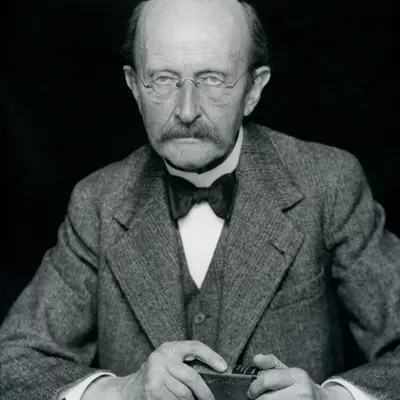
In 1900, German physicist Max Planck tackled this problem. He was searching for a formula that would match the experimental data across the entire spectrum, from red to ultraviolet. After much effort, he found a mathematical expression that perfectly fit the observed blackbody radiationBlackbody RadiationBlackbody radiation is the electromagnetic radiation emitted by an idealized object that absorbs all incident radiation and reflects none. full glossary entry curves.
However, to derive this formula, Planck had to make a radical assumption. He proposed that energy is not emitted continuously, but rather in discrete, indivisible packets. He called these packets quantaQuantumA quantum is the smallest possible discrete unit of any physical property, such as energy or matter. full glossary entry (the singular is “quantum”). Think of it like a ramp versus a staircase. Classical physics imagined energy being emitted smoothly, like rolling a ball down a ramp. Planck’s idea was that energy could only be emitted in distinct steps, like going down a staircase, one step at a time.
Crucially, Planck proposed that the energy of each of these packets was directly proportional to the frequencyFrequencyHow often a repeating event or wave pattern occurs in a given amount of time. Higher frequency means more repetitions per second. full glossary entry of the light wave. FrequencyFrequencyHow often a repeating event or wave pattern occurs in a given amount of time. Higher frequency means more repetitions per second. full glossary entry describes how many wave cycles pass a point per second. Higher frequency light, like blue or ultraviolet, carries more energy per packet than lower frequency light, like red. The constant of proportionality that linked energy and frequency became known as Planck’s constantPlanck's ConstantPlanck's constant is a fundamental physical constant that relates the energy of a quantum of energy to its frequency. full glossary entry , denoted by the letter ‘h’.
Planck himself was deeply uncomfortable with this idea. He considered it a mathematical trick, a desperate measure to make his formula work, rather than a true description of nature. He hoped that a better explanation would eventually emerge from classical physics.
Yet, Planck’s “act of desperation” proved to be much more than a mathematical trick. Within five years, in 1905, another brilliant physicist, Albert Einstein, took Planck’s idea seriously. Einstein used the concept of energy quantaQuantumA quantum is the smallest possible discrete unit of any physical property, such as energy or matter. full glossary entry to explain the photoelectric effect, an unrelated phenomenon where light striking a metal surface ejects electrons. Einstein showed that light itself behaves as if it’s made of these discrete energy packets, which we now call photons.
This was the true beginning of quantumQuantumA quantum is the smallest possible discrete unit of any physical property, such as energy or matter. full glossary entry physics. Planck’s reluctant insight, initially seen by him as a computational convenience, shattered the classical view of the universe. It revealed that energy, at its most fundamental level, is not infinitely divisible but comes in specific, measurable bundles. This revolutionary idea laid the groundwork for understanding the structure of atoms, the behavior of subatomic particles, and ultimately led to technologies like lasers, transistors, and medical imaging. Max Planck, despite his initial reservations, had inadvertently opened the door to a new era of physics.