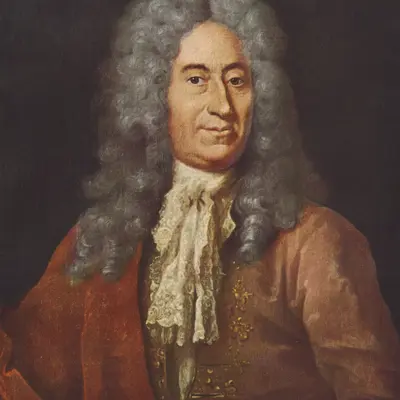
Imagine flipping a light switch. Instantly, the room is bathed in light. This everyday experience makes it seem as though light arrives everywhere at the same moment, without any delay. For most of human history, this was the prevailing assumption: light traveled infinitely fast. But in 1676, a Danish astronomer working in Paris, Ole Rømer, used a distant moon to prove otherwise.
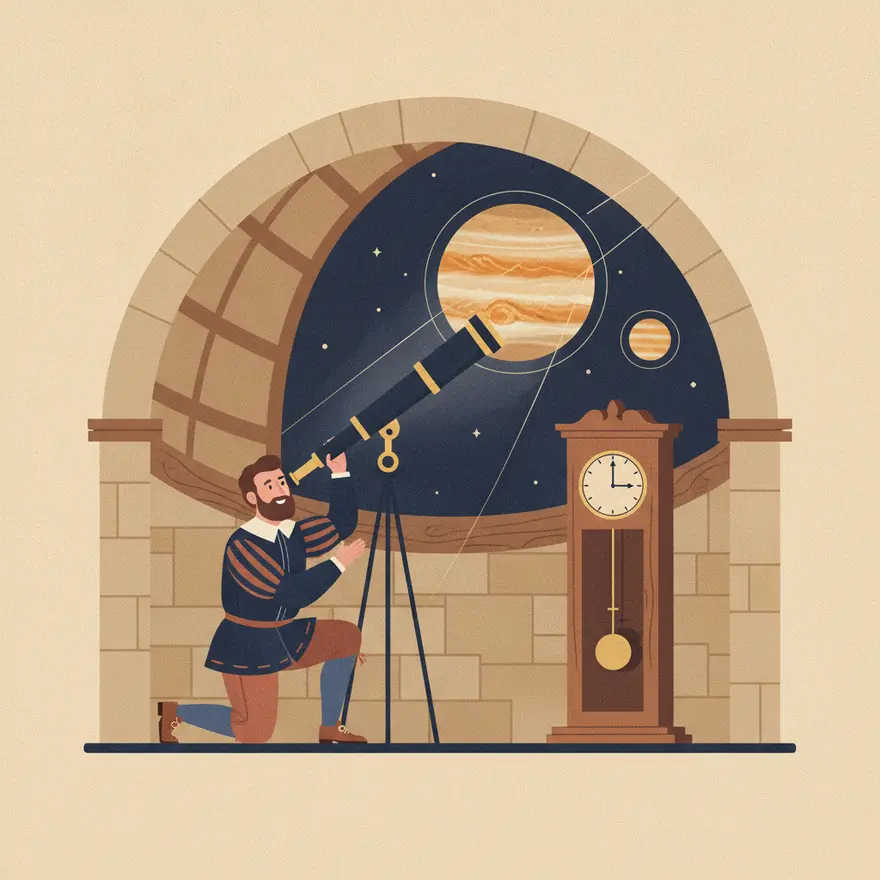
The challenge was immense. How do you measure the speed of something that appears to have no travel time at all? Any terrestrial experiment would be far too small to reveal a delay. Rømer needed a clock that operated on a cosmic scale. He found it in the gas giant Jupiter and its innermost large moon, Io.
Io orbits Jupiter, regularly disappearing behind the giant planet. This event, when a celestial body passes into the shadow of another, is called an eclipseEclipseAn eclipse occurs when one celestial body passes into the shadow of another, or when one body passes in front of another from an observer's perspective, blocking its light. full glossary entry . Because Io’s orbit is so regular, its eclipses behind Jupiter are highly predictable, acting like a reliable clock in the sky.
Rømer, along with other astronomers at the Paris Observatory, meticulously observed these eclipses. They built tables predicting when Io would vanish and reappear. For a while, the predictions seemed accurate. But over many months, Rømer noticed a pattern that didn’t fit. The eclipses weren’t always happening exactly on schedule.
Sometimes, when Earth was relatively close to Jupiter in their respective orbits, Io’s eclipses occurred earlier than predicted. Six months later, when Earth had moved to the opposite side of its orbit and was thus much farther from Jupiter, the eclipses occurred later than predicted. The schedule itself, the actual timing of Io disappearing behind Jupiter, was not changing. What was changing was when observers on Earth saw it happen.
Rømer’s brilliant insight was that the varying timings were due to the changing distance the light from Io had to travel to reach Earth. When Earth was closer to Jupiter, the light had a shorter journey, so it arrived sooner. When Earth was farther, the light had a longer journey, taking more time to bridge the greater distance. This concept, the time it takes for light to travel a certain distance, is known as light-timeLight-timeLight-time refers to the duration it takes for light to travel a specific distance through space. full glossary entry .
By measuring the maximum delay in the eclipse timings, Rømer could determine the extra time light needed to cross the diameter of Earth’s orbit. At the time, the size of Earth’s orbit was not known with great precision, but astronomers had a good estimate of its diameter, which we now call two astronomical unitsAstronomical UnitAn astronomical unit (AU) is a unit of distance used in astronomy, approximately equal to the average distance from the Earth to the Sun. full glossary entry . An astronomical unit is roughly the average distance from the Earth to the Sun. Using the observed timing difference and the best available data for the size of Earth’s orbit, Rømer made a calculation.
Rømer’s result was not perfectly accurate by modern standards. He calculated that light took about 22 minutes to cross the diameter of Earth’s orbit. While this was a significant underestimate compared to the true value, the specific number was less important than the profound qualitative discovery. Rømer’s work provided the first compelling evidence that light travels at a finite, measurable speed, and not instantaneously.
This was a monumental shift in scientific understanding. It showed that light, like everything else, takes time to travel through space. It opened the door for future experiments and more precise measurements, fundamentally changing how physicists and astronomers would view the universe. Rømer’s clever use of a celestial clock demonstrated that profound truths can be uncovered by carefully observing the subtle discrepancies in the natural world.