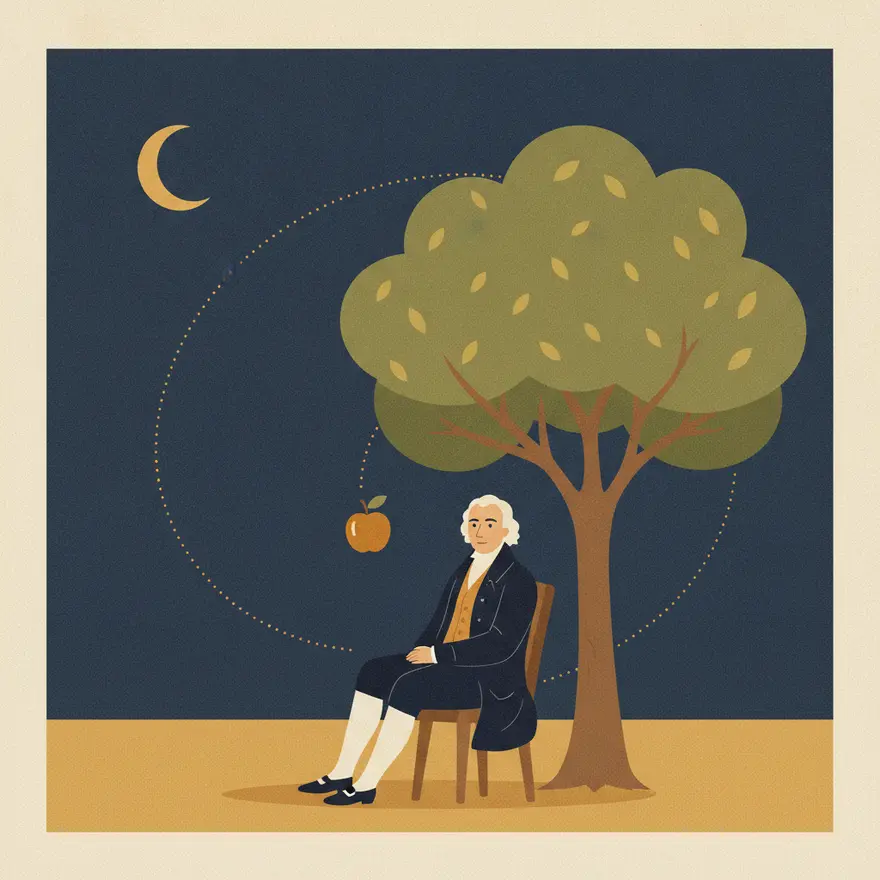
An apple falls from a tree to the ground. The Moon hangs in the sky, circling Earth without ever falling down. These two events seem utterly unrelated, happening in different realms. But in the late 17th century, Isaac Newton saw a profound connection, revealing a single, elegant rule that governs both.
Before Newton, the prevailing view was that the heavens and the Earth operated under entirely different sets of rules. On Earth, objects had a natural tendency to fall. In the heavens, planets and moons moved in perfect, eternal circles. The two realms were considered fundamentally separate. How could the same universe contain such different behaviors?
Newton’s genius was to erase this distinction with a single, powerful thought experiment. He asked us to imagine a cannon on a very high mountaintop. Fired with a little powder, the cannonball travels a short distance before falling to the ground. With more powder, it travels further. Newton realized that if you could fire the cannonball with enough speed, its path would curve downwards at the same rate that the Earth’s surface curves away. The cannonball would still be falling, but it would never get any closer to the ground. It would perpetually miss. This state of continuous falling, matched by sideways motion, is what we call an orbitOrbitAn orbit is the curved path an object takes around another object due to gravitation. It is a continuous state of falling while also moving sideways fast enough to miss the central object. full glossary entry . The Moon, he reasoned, is just like that cannonball. It is constantly falling toward Earth.
Newton proposed that the very same force pulling the apple to the ground is the one holding the Moon in its path. He called this universal force gravitationGravitationGravitation is the fundamental force of attraction that exists between any two objects that have mass. The more massive the objects, the stronger their gravitational pull. full glossary entry . His groundbreaking idea was that this was not a force unique to Earth. It was a property of all matter. Every particle in the universe attracts every other particle with a force that depends on two simple things: how much stuff (or mass) the objects have, and how far apart they are.
The more massive the objects, the stronger their mutual pull. But the force weakens dramatically with distance. Newton calculated that the strength of gravity follows a precise rule. If you double the distance between two objects, the gravitational pull between them drops to one-quarter of its original strength. Triple the distance, and the force becomes nine times weaker. This relationship is known as the inverse-square lawInverse-Square LawThe inverse-square law describes how the strength of a physical quantity, such as gravitational force, decreases proportionally to the square of the distance from its source. full glossary entry . It was this mathematical precision that allowed Newton to test his idea against the known movements of the planets and the Moon.
In his monumental 1687 work, Philosophiae Naturalis Principia Mathematica (Mathematical Principles of Natural Philosophy), Newton laid out this unified theory. With a single set of equations, he could predict the path of a falling object (the popular story of the apple, while likely embellished, illustrates the core idea), the Moon’s journey around Earth, and the planets’ movements around the Sun. He described how gravity works with stunning accuracy, but he did not pretend to know why it works. In a later edition of his book, he famously stated, “I frame no hypotheses” regarding the underlying cause, focusing instead on providing a mathematical description of its measurable effects.
The true wonder of Newton’s law was its universality. It demolished the ancient barrier between the terrestrial and the celestial. The universe, from a falling pebble to a distant planet, was shown to operate under one consistent, predictable law. This had profound consequences. For the first time, astronomers could accurately predict the return of comets and explain the ocean tides as a gravitational interaction between the Earth, Moon, and Sun. The cosmos was no longer mysterious and divine, but a grand, clockwork mechanism that could be understood through reason and mathematics.
Newton’s law of gravitation remains one of the cornerstones of physics. While Albert Einstein’s theory of general relativity later provided a more complete picture of gravity, Newton’s equations are still what we use for nearly all practical purposes. They guide the launch of satellites, plot the course for interplanetary probes, and help astronomers understand the motions of stars and galaxies. The simple rule that Newton discovered by connecting a falling apple to the orbiting Moon is still at work today, charting our path into space.