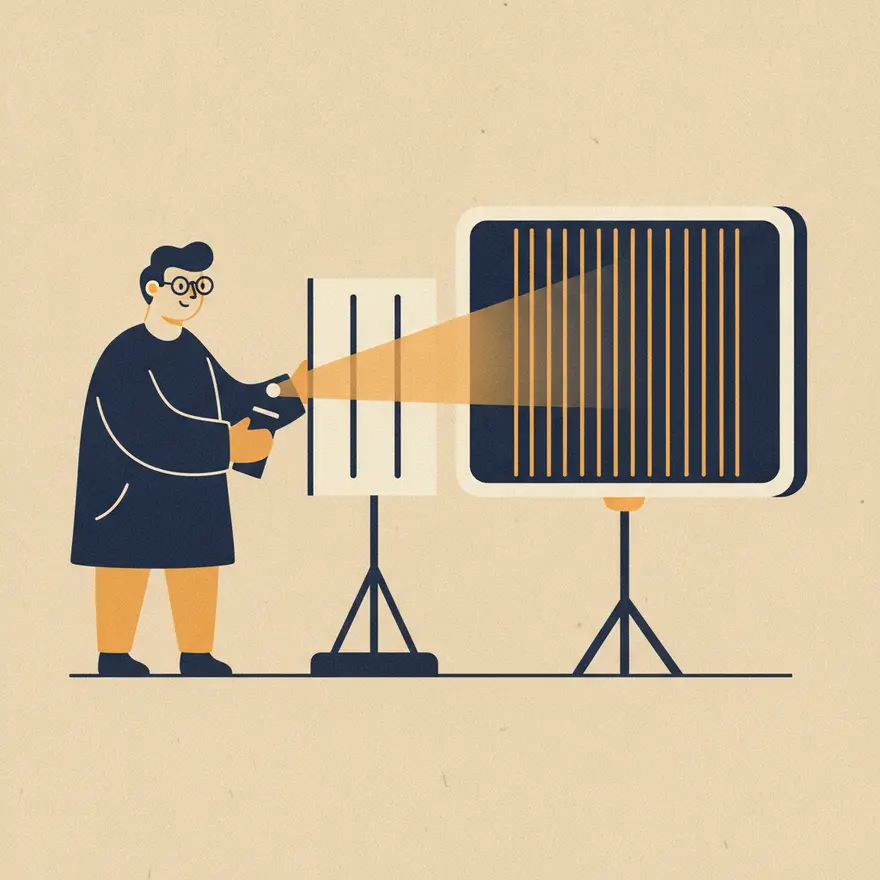
Imagine shining a light through two tiny, narrow slits. What do you expect to see on a screen behind them? Most people would picture two bright lines, corresponding to the light passing through each slit. However, what actually appears is a striking pattern of alternating bright and dark stripes, almost like a barcode. This peculiar result reveals something fundamental about light: it travels as a wave.
For over a century, the prevailing view of light was shaped by Isaac Newton. He had proposed that light was made of tiny, fast-moving particles. This idea, backed by Newton’s immense authority, was widely accepted and seemed to explain many optical phenomena, such as reflection and refraction.
However, waves behave differently from particles. Think about ripples on a pond. If two ripples meet, they can either combine to make a bigger ripple (if their peaks align), or they can cancel each other out, leaving flat water (if a peak from one meets a trough from the other). This phenomenon, where two or more waves overlap and combine to form a new wave of greater, lower, or the same amplitude, is called interferenceInterferenceThe phenomenon where two or more waves overlap and combine to form a new wave of greater, lower, or the same amplitude. full glossary entry . Particles, on the other hand, would simply pass by each other or collide.
Around 1801, the English polymath Thomas Young set out to test the nature of light. He devised a simple but profound experiment. He directed a beam of light, first through a single slit to create a coherent source (meaning the waves are in step), and then through two closely spaced slits onto a screen.
The pattern Young observed was not two bright spots, but a series of alternating bright and dark bands. The bright bands appeared where light waves arrived in step, adding their energy together (constructive interference). The dark bands, crucially, appeared where light waves arrived out of step, cancelling each other out (destructive interference). This could only happen if light was a wave, not a stream of particles. The distance between two consecutive peaks or troughs of a wave is known as its wavelengthWavelengthThe distance between two consecutive peaks or troughs of a wave. full glossary entry . Young’s experiment even allowed for the calculation of light’s wavelength based on the spacing of these bands.
Young’s findings, presented in his 1804 Bakerian Lecture, directly challenged Newton’s established particle theory. His work faced significant skepticism and even ridicule in Britain, largely due to the reverence for Newton. For years, the wave theory of light struggled for acceptance. However, as more evidence accumulated, particularly from French physicists like Augustin-Jean Fresnel, the wave theory gradually gained widespread recognition.
Young’s experiment provided compelling evidence that light exhibits wave-like properties. While later quantum mechanics revealed that light also behaves as particles (photons) in certain situations, Young’s double-slit experiment remains a cornerstone of physics, demonstrating the wave nature of light in a beautifully simple way.