Imagine firing a cannonball at a thin sheet of tissue paper. You would expect it to tear straight through. Now imagine that, very rarely, one of those cannonballs bounces right back at you. This seemingly impossible event is a good analogy for an experiment that completely changed our understanding of matter.
At the start of the 20th century, scientists had a working picture of the atomAtomThe smallest unit of an element that retains the chemical identity of that element. full glossary entry , the basic building block of matter. It was known as the “plum pudding” model. This model suggested an atom was a soft, diffuse sphere of positive charge, with negatively charged electrons embedded within it, like plums in a pudding.
This model made a clear prediction. Since the positive charge was spread thinly throughout the atom’s entire volume, the repulsive force it could exert on any incoming particle would be quite weak. A positively charged particle fired through it would feel a gentle push from all sides, but never a single, powerful shove. Physicists expected any such particles to pass through a thin material with, at most, very minor changes in their path. It would be like a bullet passing through a light fog.
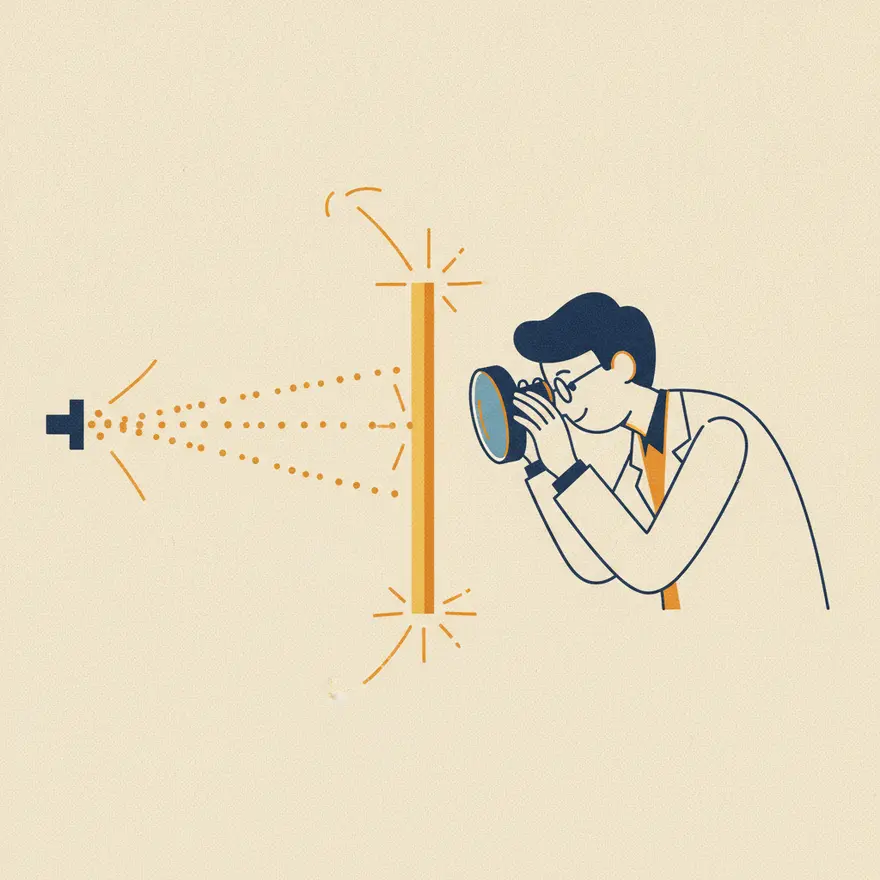
In 1909, at the University of Manchester, physicist Ernest Rutherford directed his colleagues Hans Geiger and Ernest Marsden to test this model. Their experiment was elegant and direct. They used a radioactive source that emitted alpha particlesAlpha particleA small, fast, positively charged particle thrown out by some radioactive atoms. It is actually the nucleus of a helium atom: two protons and two neutrons. full glossary entry , which are small, dense, and positively charged. They aimed a narrow beam of these particles at an extremely thin sheet of gold foil, just a few thousand atoms thick. Surrounding the foil was a movable screen coated in a material that produced a tiny flash of light whenever an alpha particle struck it. By moving the screen, they could precisely map where the particles went after hitting the foil.
The results were not what the plum pudding model predicted. As expected, the vast majority of alpha particles sailed straight through the foil, barely disturbed. But a small number were deflected at large angles. Even more unexpectedly, a very tiny fraction, about 1 in 8,000, bounced almost straight back toward the source. Rutherford later recalled the result was as incredible as if you fired a 15-inch shell at a piece of tissue paper and it came back and hit you.
Rutherford realized these results demanded a completely new model of the atom. The fact that most alpha particles passed through undeterred meant the atom was indeed mostly empty space. But the large-angle deflections were the key. The gentle, spread-out positive charge of the plum pudding model could never produce such a sharp turn.
He reasoned that the only way for a particle to be so strongly repelled was if the atom’s positive charge, and nearly all of its mass, were concentrated in an incredibly small, dense volume. This tiny core would create a powerful electric field. An alpha particle passing by at a distance would be unaffected. But one that came close to this central charge would be strongly repelled, its path bent sharply. A particle on a direct collision course would be stopped by the immense repulsive force and thrown straight back.
In 1911, Rutherford published his conclusion. He proposed that every atom has a tiny, dense, positively charged core, which he would later call the atomic nucleusAtomic nucleusThe tiny, dense core at the centre of an atom. It holds nearly all the atom's mass and its positive charge, with the rest of the atom mostly empty space. full glossary entry . The electrons, he suggested, orbited this nucleus at a great distance, leaving the rest of the atom as vast, empty space.
This discovery was revolutionary. It established that the solid world we perceive is an illusion of sorts. Matter is not solid at all, but composed of atoms that are almost entirely empty. To put it in perspective, if an atom were the size of a large sports stadium, its nucleus would be the size of a marble sitting on the center spot. The electrons would be like tiny specks of dust whirling around in the vast emptiness of the stands. The gold foil in the experiment felt solid only because of the powerful electric forces between these nuclei and their electrons.
Rutherford’s nuclear model, born from the simple act of firing particles at foil, became the new foundation of physics. It explained the scattering results perfectly and set the stage for all of modern atomic and nuclear science, from understanding chemical bonds to unlocking the energy held within the atom’s core.